Justice for Joe. Public records, forensic evidence, media coverage and the Moralez family’s allegation that institutional protection and corruption have prevented a legitimate independent investigation.
FCSO • Fresno County Sheriff • Case 040028063
FCSO Records in the Jose Moralez Case
The 2025 release provides the 39-page redacted Fresno County Sheriff’s Office investigative packet and separate toxicology, firearm-comparison and GSR reports. ChiefDyer.com publishes those records beside the original archive and examines the forensic limits, the family’s homicide theory, disputed attribution issues and the questions the produced record still does not resolve.
Primary recordsFCSO 040028063
Main investigative packet + separate forensic laboratory material.
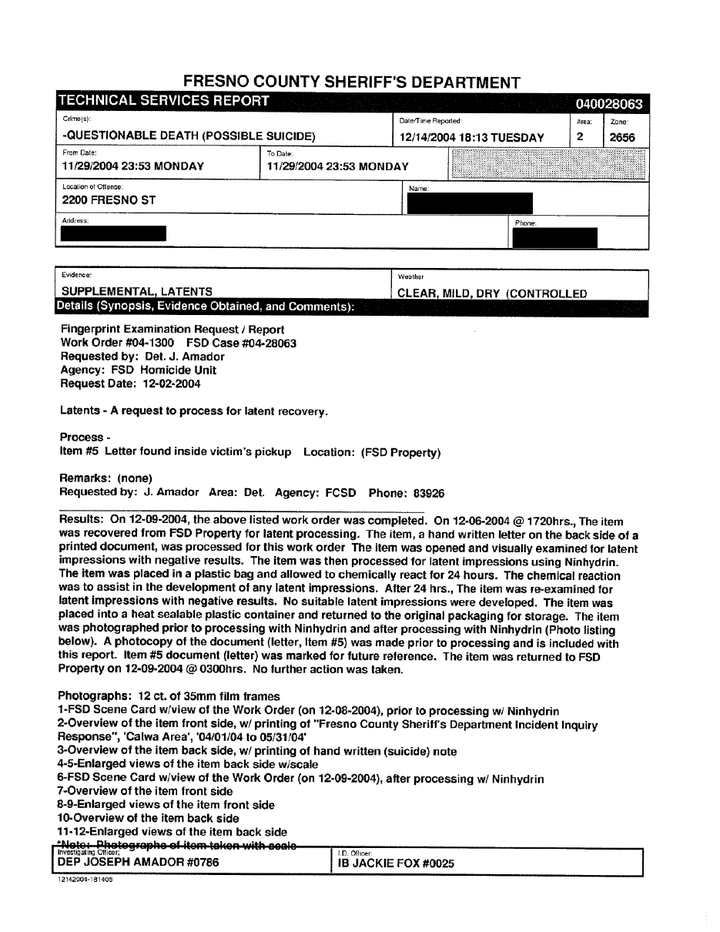
1. The produced file documents a handwritten note.
The crime-scene records list a handwritten item recovered from the front-right passenger seat of Jose Moralez’s Chevrolet pickup. A follow-up narrative states that Yolanda Moralez reviewed a copy and confirmed that the writing was her husband’s handwriting. A later latent-print report refers to the item as a handwritten suicide note and reports that processing did not develop comparable latent impressions of value.
What this establishes: the produced record contains a note and a family handwriting identification. What it does not establish: the note does not identify the person who fired the fatal shot, and the latent examination did not develop comparable impressions of value from the item.
FCSO latent-print report from the redacted investigative packet.Verified record
2. GSR testing appears in the released file, but attribution to Jose Moralez is disputed.
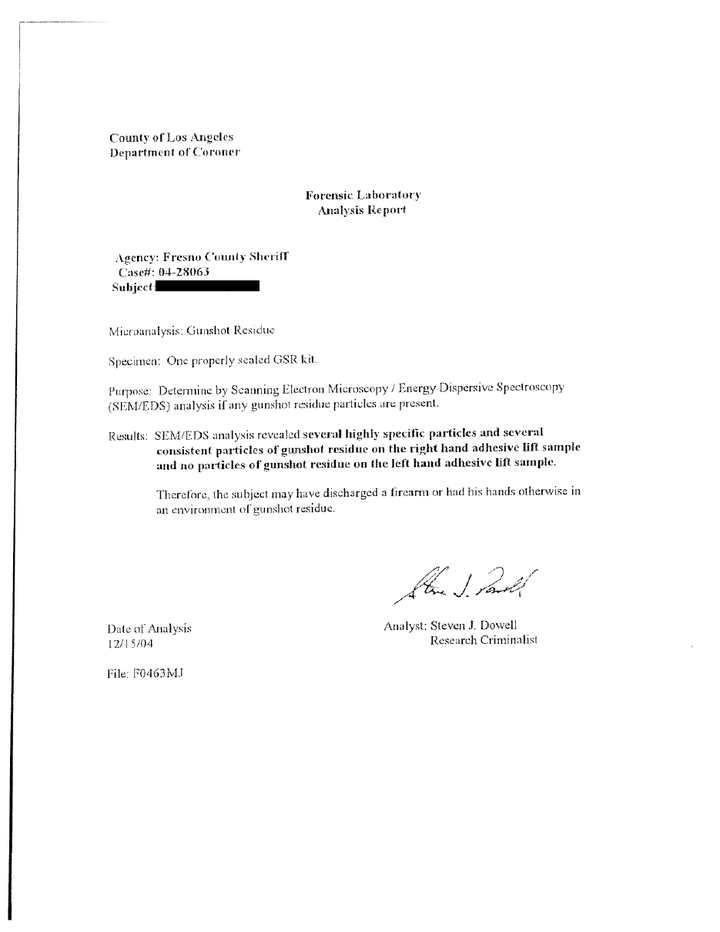
The Los Angeles County Department of Coroner forensic laboratory report states that SEM/EDS analysis revealed several highly specific particles and several consistent particles of gunshot residue on the right-hand adhesive lift sample and no particles of gunshot residue on the left-hand adhesive lift sample.
The same laboratory report states that the result means the subject may have discharged a firearm or may otherwise have had his hands in an environment containing gunshot residue. The FCSO follow-up narrative records the same right-hand/left-hand result.
What the released page shows: the laboratory records particles on a right-hand adhesive lift and none on a left-hand lift. The subject name is redacted on the public copy. The family’s position: no valid GSR result has been established as belonging to Jose Moralez. ChiefDyer.com therefore treats attribution, collection provenance and evidentiary significance as disputed rather than presenting the redacted result as proof that Jose fired the fatal shot.
Forensic context
GSR does not, by itself, establish how particles arrived on a person. Current NIST guidance explains that particles may be associated with firing a weapon, being near a discharge or contact with a residue-bearing surface, and that the examination cannot determine the transfer mechanism by itself.
Redacted GSR laboratory report included in the FCSO records release.Verified record
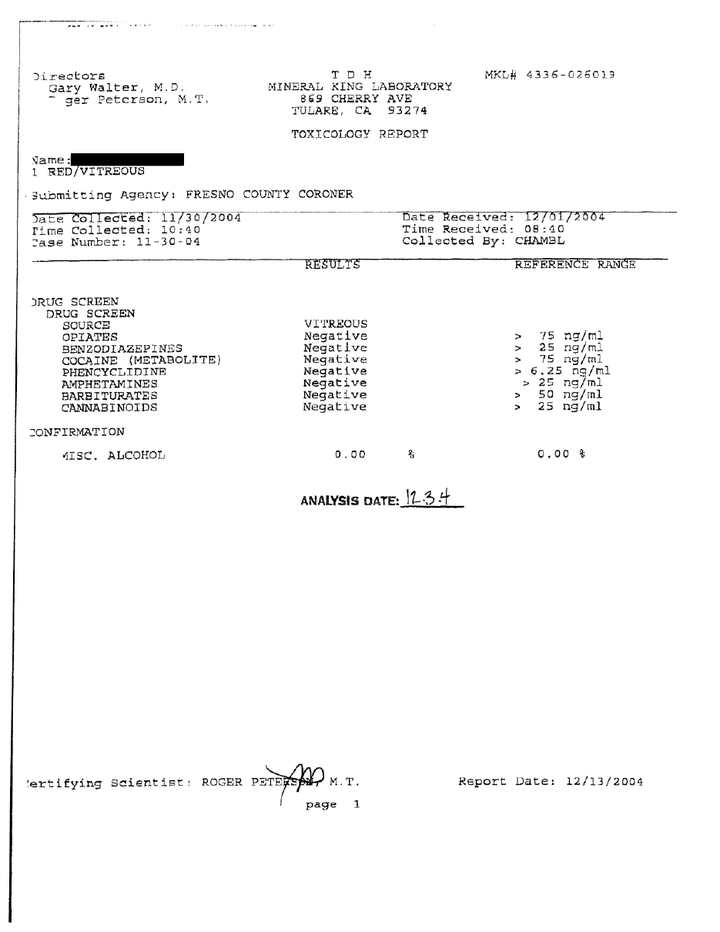
3. The released toxicology report shows 0.00% alcohol and negative listed drug screens.
The redacted Mineral King Laboratory pages included in the records release report 0.00% blood alcohol and show the listed screens as negative for opiates, benzodiazepines, cocaine metabolite, phencyclidine, amphetamines, barbiturates and cannabinoids. A vitreous-specimen page likewise reports 0.00% alcohol and negative listed screens.
The released toxicology pages report 0.00% alcohol for the specimens shown. ChiefDyer.com publishes those pages as part of the forensic record to be considered with the complete autopsy, scene evidence and chronology.
One of the redacted toxicology pages included in the FCSO forensic packet. Readers should consult the full PDF rather than relying on this excerpt alone.Verified record
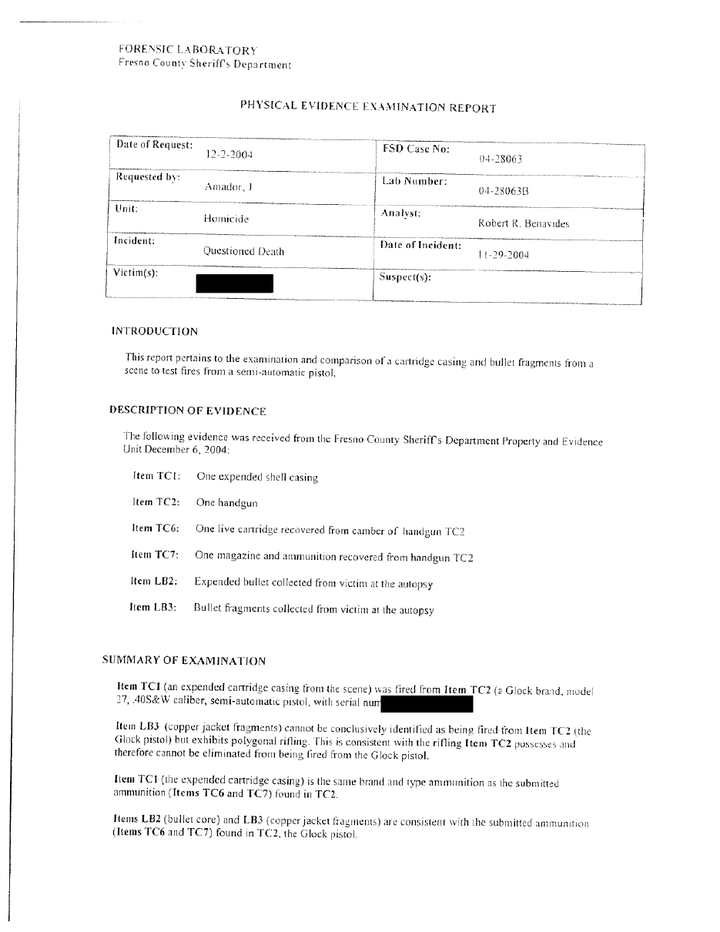
4. The firearm-comparison report identifies the recovered weapon as a Glock Model 27, .40 S&W.
The forensic report identifies the recovered firearm as a Glock Model 27, .40 S&W semi-automatic pistol. It reports that the scene cartridge casing (TC1) was fired from that recovered Glock (TC2).
The report further states that the bullet core and jacket fragments collected as autopsy evidence were consistent with the submitted .40 S&W ammunition. The jacket fragments showed polygonal rifling characteristics consistent with a Glock barrel, but the report says there were insufficient individualizing marks to identify those fragments conclusively as having been fired from that specific pistol.
The firearm-comparison report links the recovered scene casing to the submitted Glock. It does not identify who fired the weapon, and the autopsy jacket fragments were not conclusively individualized to that specific pistol.
Redacted firearm-comparison report from the forensic packet. The full report is available in the document library.Verified record
5. The crime-scene report identifies the casing, Glock, passenger-seat items and related evidence.
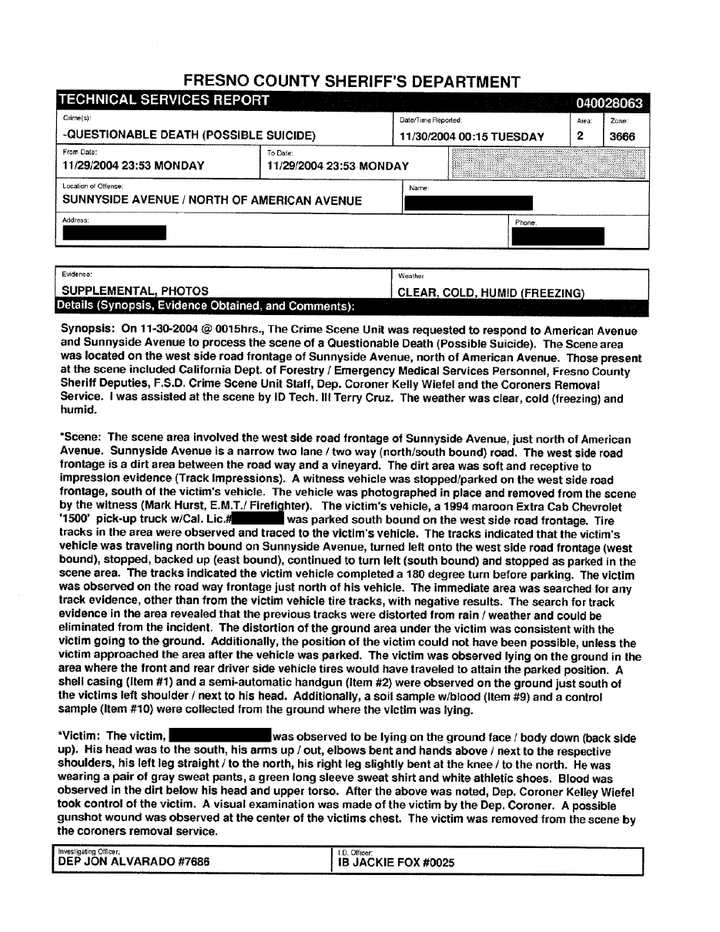
The crime-scene report records an expended casing south of the decedent’s head and a loaded Glock handgun on the ground south of his head. It also lists a black fanny/gun pack, a Bible and papers, and the handwritten item from the truck’s front-right seat, along with dirt samples, the live chambered round, magazine/ammunition, wallet and a barrel swab.
The report states that blood was observed on the gun, inside the barrel, and on the live round and magazine. The scene narrative describes Jose lying face/body down on the road frontage north of his vehicle and records a possible gunshot wound in the center of the chest. It also documents tire-track and ground-distortion observations. Those scene details should be tested against photographs, measurements, trajectory evidence, witness accounts and any complete autopsy reconstruction.
FCSO crime-scene summary from the redacted investigative packet.Unresolved reporting-caller record
6. Who reported the body—and where are the complete phone records?
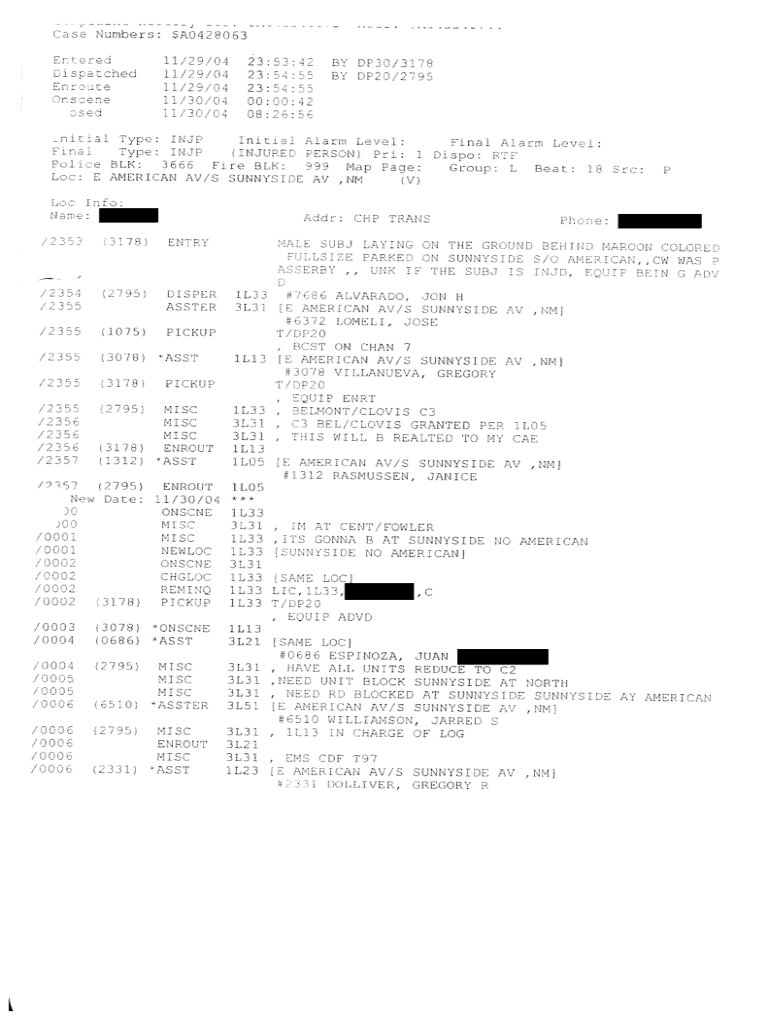
The released FCSO call-for-service record shows the initial location information as “CHP TRANS”, with the caller’s name and telephone number redacted. The dispatch entry reports a male subject on the ground behind a maroon full-size vehicle near Sunnyside and American. The public release does not identify the reporting person on that page.
In a May 15, 2025 CPRA demand, Tommy Sevilla requested the 911 audio, CAD logs, caller phone records, caller identity and follow-up interview records. That demand states that the caller was never publicly identified, that internal records indicated the caller went to Los Angeles County, and that no known follow-up interview had been produced.
In an April 25, 2025 formal complaint sent to the U.S. Attorney and Sheriff John Zanoni, Sevilla further alleged that the reporting caller’s cell number was disconnected immediately after the report, that efforts to obtain those records were stonewalled, and that Jose Moralez’s own phone records were kept from public disclosure. Those are records-suppression allegations made in the family’s formal complaint. The underlying subscriber, carrier, call-detail, location, CHP-transfer and court records should be produced so the claims can be tested directly.
Released FCSO call-for-service page. The caller name and telephone number are redacted; the source line reads “CHP TRANS.”Recorded witness account
7. The follow-up report records Jerry Dyer’s chronology.
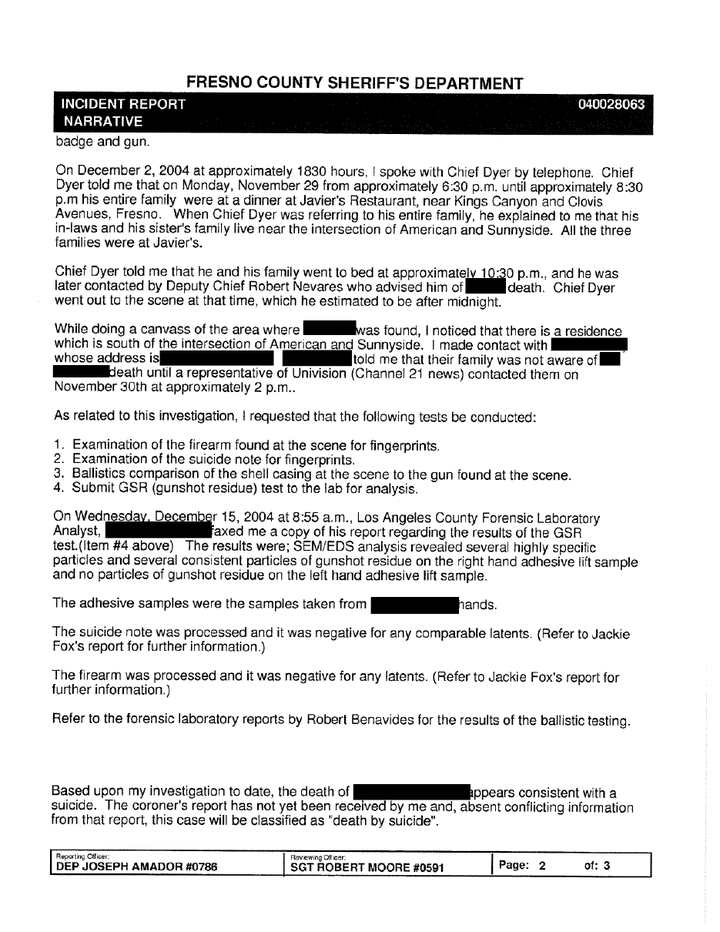
The report states that Dyer told the investigator that on November 29, 2004, he and his family were at Javier’s Restaurant near Kings Canyon and Clovis Avenues from approximately 6:30 p.m. until approximately 8:30 p.m.; that his family went to bed at approximately 10:30 p.m.; and that he later went to the scene after being contacted by Deputy Chief Robert Nevarez. The report also records Dyer explaining that relatives lived in the vicinity of American and Sunnyside.
This is Dyer’s recorded account. The central investigative question is whether restaurant records, phone records, dispatch logs, witnesses and other contemporaneous evidence corroborate each material part of that timeline.
FCSO follow-up page recording Dyer’s account and the investigator’s forensic requests/results.Unresolved questions
8. The released records still do not answer who fired the fatal shot.
The reviewed release supplies the main investigative packet, redacted toxicology pages, firearm-comparison results and the GSR report. The materials currently published here do not include a standalone complete narrative autopsy report. Phone records and other independently authenticated chronology evidence also remain relevant to testing competing accounts.
The FCSO follow-up states that the case was classified as suicide based on the investigation to that point. ChiefDyer.com’s position is that the classification should not end the inquiry. The produced records add important evidence, but they do not identify the shooter, conclusively reconstruct the fatal shot, or resolve the family’s allegations concerning the scene, chronology and investigation. Those issues warrant independent review using the complete forensic and documentary record.
ChiefDyer.com / Justice for Joe is an advocacy and public-record site presenting the Moralez family’s homicide and cover-up allegations, witness accounts, records, forensic disputes and government responses. Allegations of criminal conduct are identified as allegations or attributed witness claims unless established by an authoritative adjudication. Primary records and published responses are linked where available.